New Zealand4/5 (2 reviews)
Volunteer with wildlife in New Zealand
In an isolated nature sanctuary in New Zealand, help protect the kiwi and native species alongside forest rangers.
- Where
- New Zealand
- Length
- From 2 to 12 weeks
- Minimum age
- 18 years old
- Language
- English intermediate
- Departures
- Every Monday
from €1,690 for 2 weeks
Check availabilityTalk to the teamNo commitment. Anaëlle, Amélie or Maëlia will reply.
The project
New Zealand is home to a number of birds and plants that can be found nowhere else in the world! The kiwi bird, probably the most well-known native New Zealand bird, is continually under threat from invasive predators like stoats, possums, pigs and other predators. An average of 27 kiwi birds are killed every week: that’s a population decline of around 1,400 kiwi every year. To think that just 100 years ago the kiwi bird numbered in the millions and that it could disappear from New Zealand shores in this lifetime is shocking. Without the assistance of conservationists and volunteers it is likely this amazing bird would become extinct. This is just one example of how New Zealand’s natural habitat is under threat.
Our nature reserve is located in a unique forest setting overlooking the ocean. It is not a tourist attraction but a nature sanctuary located 250 km from a major city, 50 km from the nearest supermarkets and 2 km from the nearest homes.
We work very closely with the Ministry for the Environment, and our volunteers have the opportunity to work hand in hand with forest rangers and learn the latest nature conservation techniques. We also take our eco-volunteers on excursions in the region to swim in nearby lakes, climb the surrounding hills and spend time at the beach. We teach them a sustainable way of life using solar energy and rainwater.
Eco-volunteer tasks
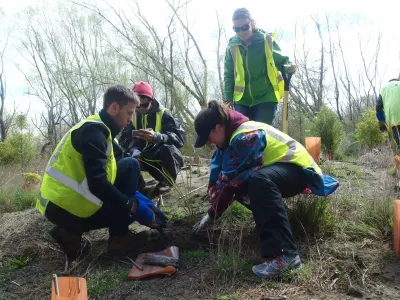
Eco-volunteers work together to keep the living areas in good condition and take part in other domestic tasks around the sanctuary. This includes gardening, looking after the vegetable garden, painting and building shelters. Working hours are allocated according to the tasks to be done at the sanctuary at the time of the programme and to the weather conditions. Tasks include a variety of conservation work such as identifying, marking and mapping forest trails, studying plants and species such as New Zealand’s kiwis and other endangered species, maintaining the grounds and taking part in various maintenance work.
Eco-volunteers will carry out a number of exercises to learn the basics of forest navigation and, over the course of their stay, they will develop the skills they need to gain the confidence to venture into the wild.
A project we follow
Projects chosen with care and followed through regular visits on site.
A typical week
Activities vary according to the season, the weather and the volunteers’ wishes:
- 8 am to 9 am: breakfast.
- 9 am to 12 pm: conservation activity.
- 12 pm to 1 pm: lunch or picnic.
- 1 pm to 4 pm: conservation activity.
- 4 pm to 6 pm: free time.
- 6 pm to 8 pm: dinner.
- 8 pm to 10 pm: free time.
Accommodation and meals
Accommodation is basic but functional. We do not offer the same comfort as at home, but clean dormitories to sleep in and hot showers. Volunteers can also choose to sleep in a tent in the trees. The suspended tents are comfortable and bring you closer to nature.
Some examples of meals: fresh vegetable stir-fry, organic beef burgers, rösti, polenta, couscous, tabbouleh, homemade falafel and hummus, blueberry crumble, pancakes. Group members are invited to help prepare the meals. We have also just built a new wood-fired pizza oven. Some treats such as chocolate and crisps are available for purchase in limited quantities, and the nearest shop is 20 km away. Volunteers can bring their own treats and snacks if they wish.
Additional information
Transport
Transport from Auckland to the project is not included in the price: you will need to take a bus to Dargaville (two buses: the first one from Auckland to Whangarei, the second one from Whangarei to Dargaville before 4:30 pm). Transport will be waiting for you in Dargaville before 5:30 pm to take you to the project (included in the price). Participants who have their own vehicle must go to the Whangarei Hub at the same time and follow the group to the sanctuary.
For the return, you will be dropped off in Dargaville on Monday at 7:30 am (for the bus to Whangarei).
Because the sanctuary is isolated, it is best to bring everything you need and to do your last shopping before leaving Whangarei. We usually go to Dargaville, the nearest town, every week. There is no guarantee that volunteers can come with us because of the limited space in the bus, but we can buy items on behalf of volunteers.
Optional: 3-night Auckland welcome pack (€250): Friday, Saturday and Sunday nights. Departure from Auckland on Monday.
- Transfer from the international airport to the hostel in the city centre.
- 3 nights in a hostel (maximum 6 beds per room) with 3 continental breakfasts.
- Free Wi-Fi at the hostel.
- Towels provided free of charge.
- Extra nights available at the time of booking.
Budget
How long are you going for?
Departure every Monday, between November and March
What is included
- Transport between Dargaville and the sanctuary
- Support and 24-hour emergency number
- Meals
- Accommodation while volunteering
- Donation to the NGO
Not included
- Flights
- Visa
- Insurance
- Transportation to and from Dargaville
Where your money goes
Donations are reinvested in full and directly into the local associations. How the costs break down
See the budget week by week
| Length | Total programme budget |
|---|
Getting ready to leave
Your application
An up-to-date CV and a cover letter describing your background and what brings you here.
Conditions to take part
- Interviews are held for all applicants wishing to stay more than three weeks, to make sure they are in line with the programme.
- We advise applicants to sign up for a maximum of 8 weeks.
- Intermediate level of English; understanding and speaking
- All volunteers must have comprehensive travel insurance.
- From 18 years old.
Insurance
For any project abroad, Freepackers requires travel insurance covering accidents, illness, repatriation and third-party liability. With Chapka Cap Student, you get 5% off.
Visa
For stays of less than 90 days, French citizens must apply for an NZeTA at https://nzeta.immigration.govt.nz/. For stays of more than 90 days, apply for a working holiday visa.
Online language lessons
With Clic Campus: video lessons and an e-learning platform, from home.
In New Zealand too
All our programmes in New Zealand
New Zealand, Timaru5(2)
Rugby course in New Zealand
- Duration
- 6 to 10 weeks
- Age
- From 15 years old
from €4,590 for 6 weeks
New Zealand5(2)
Conservation project in New Zealand
- Duration
- 2 to 8 weeks
- Age
- From 18 years old
from €1,300 for 2 weeks
